

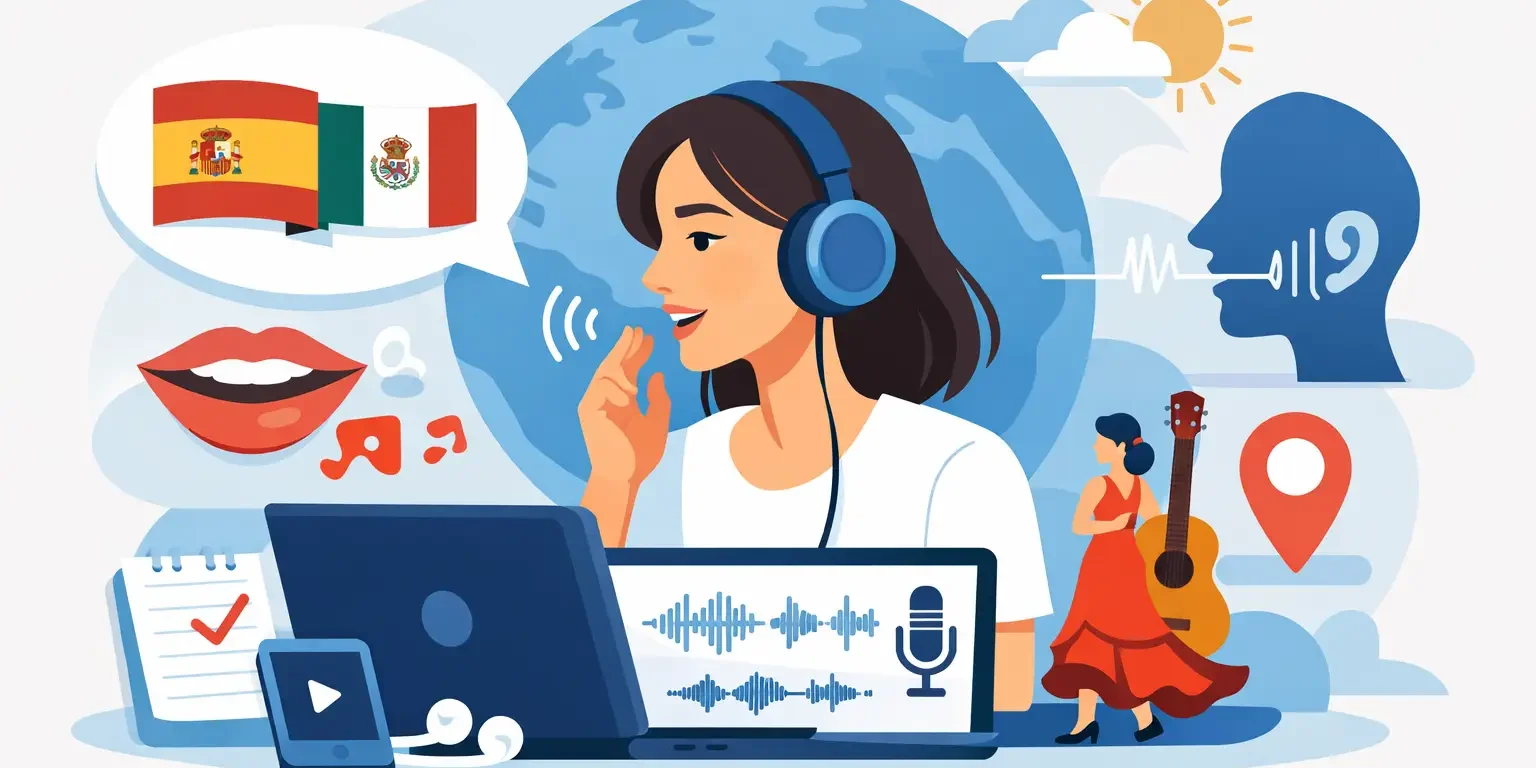
You may know exactly what you want to say in Spanish, then freeze because you are not sure how it will sound coming out. That is frustrating, but it is also fixable. Learning how to improve Spanish pronunciation is less about having a perfect accent and more about making yourself clear, sounding more natural, and feeling relaxed enough to keep the conversation going.
For English speakers, Spanish pronunciation can feel deceptively simple. The alphabet looks familiar, many words look recognizable, and then your mouth tries to turn pero into “pair-oh” or swallow half the sounds in a long sentence. The good news: Latin American Spanish has consistent sound patterns. Once you train your ear and mouth together, progress can come much faster than you expect.
Start with clarity, not a “perfect” accent
A foreign accent is not a failure. Native speakers across Latin America have different accents too. Someone from Mexico City, Medellín, Buenos Aires, and San Juan will not pronounce every sound in the same way. Your goal is not to copy one person perfectly. Your goal is to be understood without people constantly asking you to repeat yourself.
That means focusing first on sounds that change meaning or make speech hard to follow. A rolled R is cool, but it should not be your first battle. If you can say vowels clearly, put stress in the right place, and stop adding English sounds where they do not belong, people will understand you far better.
How to improve Spanish pronunciation: train the sounds English misses
Spanish uses fewer vowel sounds than English, which is actually a gift. English vowels shift all over the place depending on the word. Spanish vowels stay much more stable.
The five core vowels are a, e, i, o, u. Think of them as short, clean sounds: a as in “father,” e as in “met,” i as in “machine,” o as in “go” but without stretching it, and u as in “flute.” The exact English comparison is never perfect, but it gives you a starting point.
The common mistake is turning one Spanish vowel into two English sounds. For example, English speakers may stretch no into “no-oo” or pronounce café like “ca-fay-ee.” Keep each vowel clean and direct: no, ca-fé. Spanish has rhythm because the vowels keep moving.
Try this for two minutes a day: say pa, pe, pi, po, pu, then ma, me, mi, mo, mu, then ta, te, ti, to, tu. It may feel like a kindergarten exercise. Do it anyway. You are teaching your mouth new default positions, not cramming vocabulary.
Give the Spanish R the right amount of attention
There are two R sounds in most Latin American Spanish. The single R in pero is a quick tap, not an English R. Your tongue briefly touches the ridge behind your top teeth. The double R in perro is the rolled or trilled sound.
If the trill will not happen yet, do not let it derail you. You can still communicate well while you work on it. Start by practicing the tap in words like cara, barato, ahora, and quiero. For the stronger R, practice combinations such as tr, dr, and rr: tres, otro, alrededor, rápido. Some learners get it in a week; others need longer. It depends on your first language and how much targeted repetition you do.
Stop pronouncing letters the English way
A few letters cause a lot of unnecessary confusion. The Spanish J is a breathy sound, like the H in “house,” so José is not “Joe-zay.” The H is silent, so hola starts with the O sound. The LL and Y often sound similar in much of Latin America, usually close to the English Y in “yes,” though regional accents vary.
Also watch the B and V. In standard Spanish, they are much closer to each other than they are in English. You do not need to force a hard English V in vivir. Let a native teacher model the sound, then copy the mouth movement and rhythm rather than overthinking the label.
Listen in small pieces, then copy out loud
Passive listening helps your ear, but it does not automatically change how you speak. The fastest practical habit is short, active imitation. Choose a 10- to 20-second clip of a Latin American Spanish speaker. Listen once for meaning. Listen again and notice where the voice rises, which syllables get energy, and where words connect. Then repeat it out loud, matching the speaker as closely as you can.
This technique is often called shadowing. It works because you are practicing pronunciation in real sentences, not isolated word lists. You also pick up useful conversational music: ¿Cómo estás?, No sé, pero creo que sí, Ahorita te digo. Those tiny patterns make your Spanish sound more connected and less like each word was selected from a menu.
Keep the clip short enough that you can repeat it several times. A focused five-minute session beats 30 minutes of half-listening while you answer emails.
Learn the rhythm before you chase speed
Spanish speakers often sound fast to English learners, but speed is not the secret. Rhythm is. Spanish usually gives more even time and energy to syllables, while English compresses unstressed syllables. If you use English rhythm with Spanish words, your speech can sound choppy even when each word is technically correct.
Read a sentence aloud and lightly clap each syllable: Me gus-ta ha-blar es-pa-ñol con mis a-mi-gos. Do not rush. Keep the vowels audible. Then say it again more naturally, without the claps, while keeping that steady flow.
Word stress matters too. Spanish spelling gives you helpful clues. Words ending in a vowel, N, or S usually stress the second-to-last syllable: CA-sa, ha-BLan, co-MI-da. Other endings usually stress the final syllable: ho-TEL, ha-BLAR. An accent mark tells you the normal pattern has changed: te-LÉ-fo-no, can-CIÓN, in-GLÉS.
Misplaced stress rarely makes your Spanish impossible to understand, but it makes listeners work harder. That is exactly the kind of issue regular speaking feedback can clean up quickly.
Record yourself without judging yourself
Recording your voice is uncomfortable for almost everyone. It is also one of the most useful pronunciation tools you already have. Read three or four sentences, record them, listen back, and compare your version with a native model. Pick one thing to adjust, not ten.
Maybe your vowels are getting stretched. Maybe you are saying gracias with a heavy English R. Maybe your question intonation is flat. Make one small correction and record again. Hearing the difference gives you proof that your practice is working.
Do not wait until you “sound ready” to speak with people. Pronunciation improves through real interaction, because a real person can tell you what was clear, what was confusing, and what you can change immediately. Apps can recognize a word, but they cannot always explain why your papa sounded like papá, or help you say a phrase naturally for the country you are visiting.
Get feedback that matches your goals
The best pronunciation practice depends on why you are learning. If you are preparing for a trip to Mexico, practice greeting people, ordering food, asking for directions, and understanding common Mexican expressions. If you use Spanish with family, focus on the words and phrases you actually need at the dinner table or on a phone call. If work is your priority, rehearse introductions, numbers, names, and the questions you ask most often.
A live teacher can catch patterns you may not hear in yourself and give you exercises built around your real life. At AmigoProf, that kind of human feedback is part of the point: you get to practice with bilingual native Spanish speakers who can explain the sound in English, model it in Spanish, and help you use it in a real conversation.
Give yourself permission to sound like a learner while you learn. Speak a little slower, make the correction, laugh when your tongue gets tangled, and try again. Clear Spanish is built one repeated phrase at a time, and every conversation gives your voice another chance to feel at home.