

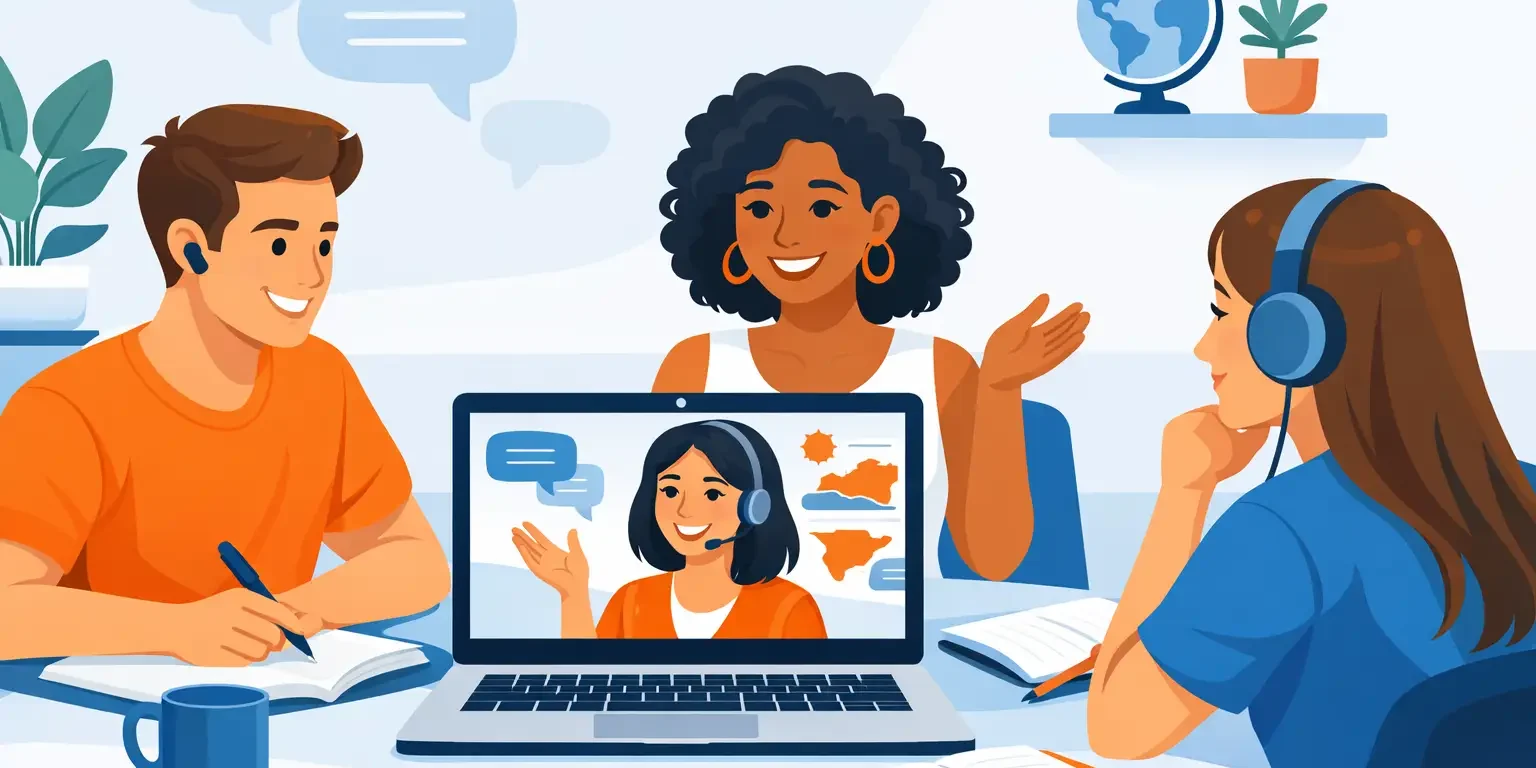
You can know plenty of Spanish words and still freeze when someone asks, ¿Qué hiciste el fin de semana? That gap between knowing Spanish and using it comfortably is exactly where fluency lives. If you are wondering how to improve Spanish fluency, the answer is not another giant vocabulary list. It is building a regular habit of understanding, responding, making mistakes, and getting back into the conversation.
Fluency does not mean sounding like you were born in Bogotá, Mexico City, or Buenos Aires. It means you can follow the point, share your own, ask for clarification, and keep going when the perfect word does not show up. That is a much more useful goal for travel, work, family, dating, or simply feeling at home in Spanish-speaking spaces.
How to Improve Spanish Fluency: Make Speaking the Main Event
A lot of learners spend months reading, tapping through exercises, and memorizing verbs before they give themselves permission to speak. Then their first real conversation feels terrifying. The fix is simple, although not always comfortable: start speaking before you feel ready.
You do not need an hour-long conversation on day one. Try answering one everyday question out loud: ¿Cómo estuvo tu día? Describe what you ate, what happened at work, or what you plan to do tonight. Your first answers may be basic. Great. Basic Spanish you can actually say is far more valuable than advanced grammar you only recognize on a screen.
Speaking becomes easier when practice has a clear purpose. Instead of saying, “I will practice Spanish,” give yourself a situation: ordering lunch, explaining a work problem, meeting your partner’s family, checking into a hotel, or discussing a TV show. You will quickly notice which words and phrases you are missing. Those are the words worth learning next.
Real-time conversation matters because it trains the skills apps cannot fully recreate. You have to listen at natural speed, react without translating every sentence, manage interruptions, and find another way to say something when you get stuck. A live teacher or conversation partner can also tell you when a phrase is technically correct but sounds too formal, outdated, or unlike something people actually say.
Stop Translating Every Sentence
Most English speakers hit a fluency wall because they build a complete English sentence in their head, then try to convert it word for word. Spanish has different sentence patterns, different filler words, and a different rhythm. Trying to translate everything perfectly makes your response slow and stressful.
Start collecting useful chunks instead. Think of these as ready-to-use building blocks:
- La verdad es que… for giving an honest opinion.
- Depende de… when the answer is not simple.
- ¿Cómo se dice…? when you need help mid-conversation.
- No estoy seguro/a, pero… when you want to keep talking even without total certainty.
- A ver si entendí bien… when you want to confirm what someone said.
These phrases buy you time and make your Spanish sound more connected. They also teach your brain to move through Spanish in pieces rather than assembling every sentence from scratch.
When you do not know a word, practice going around it. If you forget paraguas, say, la cosa que usas cuando llueve. If you cannot remember enchufe, explain that it is where you plug in your phone charger. This is not cheating. Native speakers do this in every language. The goal is communication, not passing a secret test.
Build a Weekly Routine You Can Actually Keep
The best routine is not the most ambitious one. It is the one you will still be doing three months from now. If you have a busy job, family commitments, or a packed travel schedule, a consistent 20-minute practice block can take you much further than a two-hour study marathon once a month.
A solid week includes listening, speaking, review, and one focused grammar or vocabulary goal. Listen to Latin American Spanish while commuting or walking. Then spend a few minutes repeating short sections out loud. This practice, often called shadowing, helps your pronunciation, speed, and confidence because you are copying the music of real speech instead of reading Spanish like English.
For speaking, schedule at least two live conversations each week if possible. One can be structured, where you work on a specific goal such as past tense storytelling or business introductions. The other can be more relaxed. Talk about what happened that week, react to a news story, or role-play a situation you expect to face.
Keep a small running list after each conversation. Write down the phrases you wanted to say, corrections you received, and expressions that sounded natural. Review that list before your next session. That simple loop turns mistakes into material you can use right away.
Listen to Spanish You Can Mostly Understand
You do not need to understand every single word to improve. In fact, material that is just a little challenging is often ideal. If you understand nothing, your brain has no anchor. If you understand everything, you are probably not stretching yourself much.
Choose content around subjects you already care about: sports, cooking, travel, fashion, technology, music, or current events. Aim to catch the general message first. Who is speaking? What happened? What is the speaker’s opinion? Then replay a short section and notice useful expressions or pronunciation details.
Be intentional about the Spanish you hear. Latin American Spanish includes many accents, vocabulary choices, and cultural references. That variety is a good thing, but it can feel overwhelming at first. Pick one or two accents to get familiar with, especially if you are traveling to a particular country or regularly speaking with people from one region. Later, broaden your listening so different voices do not throw you off.
Get Feedback Before Mistakes Become Habits
Confidence grows from repetition, but repetition alone can reinforce errors. If you always say something in a way that is understandable but unnatural, people may not correct you because they are being polite. A good teacher will catch the pattern, explain it clearly, and give you a better version you can practice immediately.
Ask for feedback that matches your goal. If your priority is a vacation in Mexico, you may care most about practical phrases, listening, and pronunciation. If you are preparing for meetings with clients, you may need professional vocabulary, polite ways to disagree, and help presenting ideas clearly. Someone learning Spanish for a relationship may want family conversation, humor, and the everyday slang that textbooks tend to skip.
This is where personalized live instruction earns its place. At AmigoProf, students work with bilingual native Spanish-speaking teachers who can adjust lessons to the moments they actually need Spanish for. You are not left guessing why a sentence sounds off or trying to learn conversation from a multiple-choice quiz.
Practice Being Imperfect on Purpose
Fluent speakers are not people who never make errors. They are people who recover quickly. They say perdón, correct themselves, ask a question, laugh when appropriate, and continue. If you wait until every verb tense is perfect, you will postpone the exact practice that makes speaking feel normal.
Give yourself a rule for conversations: do not switch to English at the first sign of trouble. Stay in Spanish for one more sentence. Ask, ¿Puedes repetirlo más despacio? Say, Entiendo más o menos. Try again. Each small recovery teaches you that a blank moment is not a disaster.
It also helps to measure progress differently. Do not ask only, “Am I fluent yet?” Ask whether you can do something you could not do last month. Can you tell a story in the past? Make a joke? Follow a voice note without panicking? Explain your opinion without rehearsing it first? Those are real wins, and they add up.
Make Spanish Part of Your Real Life
Spanish fluency sticks when the language has a job to do. Send a voice message in Spanish. Change the language on one device or app you use often. Cook from a Spanish-language recipe and narrate what you are doing. Keep a two-minute spoken diary at the end of the day. The activity does not have to be academic to be useful.
The key is frequency with intention. A little Spanish every day keeps your brain ready to respond, while regular human conversation gives that practice a pulse. Start with the next situation you genuinely want to handle in Spanish, practice it out loud, and let imperfect conversations carry you forward.